🦎 Reptiles in the Classroom: How Live Animals Bring Science Lessons to Life
Why Reptiles Belong in the Classroom
For many pupils, science can feel abstract — diagrams in textbooks, videos on screens, facts to memorise for a test.
But the moment a real, living animal enters the room, everything changes.
Eyes light up.
Questions start flying.
And suddenly, learning becomes memorable, emotional, and real.
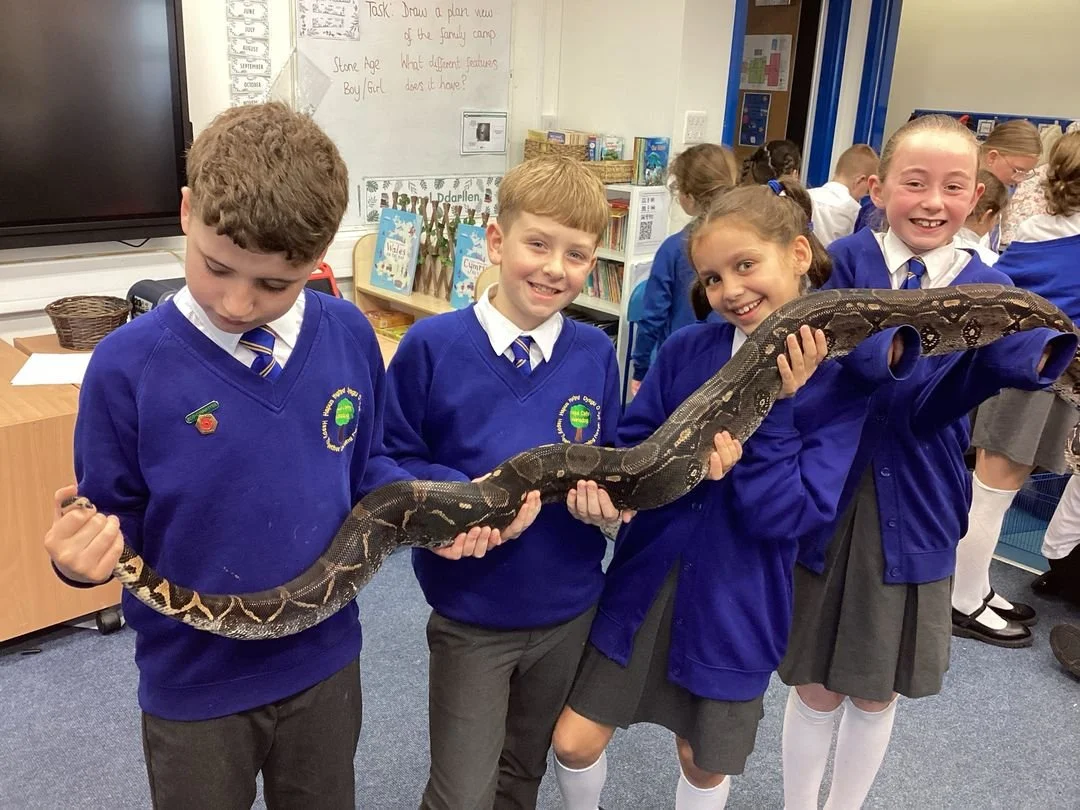
Live reptile workshops don’t just entertain — they transform learning, helping children connect classroom theory to the natural world in a way no worksheet ever could.
How Live Animals Support the Science Curriculum
Reptiles are uniquely suited to curriculum-linked learning because they allow pupils to explore multiple scientific concepts in one session.
During a reptile workshop, children can directly observe and discuss:
🧬 Classification (vertebrates, reptiles vs mammals)
🌡️ Adaptation (cold-blooded animals, habitats, survival traits)
🔄 Life cycles and growth
🍽️ Food chains and predators
🌍 Habitats around the world
🧠 Behaviour and animal welfare
Instead of imagining these ideas, pupils see them in action.
Engagement That Reaches Every Learner
One of the biggest strengths of live animal workshops is how they remove barriers to learning.
Rather than relying on one method of teaching, animal-based sessions naturally support a wide range of pupils by offering:
Concrete, real-world experiences instead of abstract concepts
Multi-sensory input that supports understanding and memory
Opportunities for observation, questioning, and discussion
Low-pressure participation, where pupils can engage at their own comfort level
Children who may struggle with traditional, desk-based learning often thrive during these sessions. Many pupils who are usually quiet, anxious, or disengaged begin asking thoughtful questions, making detailed observations, and showing confidence in their understanding.
Because the learning is grounded in a real, shared experience, pupils are able to connect more deeply with the content — and that learning is far more likely to stick.
Building Empathy and Respect for Animals
Reptile workshops aren’t just about science facts.
They also help children develop:
💚 Empathy for living creatures
🐍 Respect for animals often misunderstood or feared
🌱 Responsibility around care, handling, and welfare
🌎 Environmental awareness and conservation values
This emotional connection encourages thoughtful, compassionate attitudes that extend far beyond the session itself.
Breaking Myths and Reducing Fear
Reptiles are often surrounded by myths — especially snakes, spiders, and insects.
Seeing them up close in a calm, structured environment helps children:
Challenge fear-based assumptions
Learn factual information instead of stereotypes
Build confidence around unfamiliar animals
Understand animal behaviour rather than fearing it
For many pupils, this can be genuinely life-changing.
Flexible Workshops for Different Age Groups
Well-designed reptile workshops can be tailored for:
Early Years & KS1 – sensory exploration, simple habitats, gentle interaction
KS2 – classification, adaptation, food chains, scientific vocabulary
Secondary pupils – ecosystems, evolution, ethical discussions, welfare
This flexibility makes them suitable for whole-school enrichment days, science weeks, or topic-based learning.
Safety, Welfare, and Professional Handling
A common concern for schools is safety — for both children and animals.
Professional reptile educators ensure:
Animals are calm, healthy, and used to educational settings
Sessions are fully risk-assessed
Handling (if included) is optional, supervised, and age-appropriate
Animal welfare is prioritised at all times
This creates a learning environment that is safe, ethical, and respectful.
Why Schools Choose Reptile Workshops Again and Again
Schools often rebook live animal workshops because they:
Create lasting memories for pupils
Support multiple curriculum areas in one visit
Encourage curiosity and questioning
Require minimal preparation from staff
Offer excellent value for enrichment learning
Teachers frequently report that pupils continue talking about the animals weeks or even months later — a clear sign of deep learning.
Final Thoughts: Learning That Sticks
If the goal of education is to inspire curiosity, understanding, and respect for the world around us, live reptile workshops are a powerful tool.
They don’t just teach science.
They ignite it.
🐍 Looking for a reptile workshop for your school?
Scaly Safari offers curriculum-linked reptile workshops designed to engage pupils, support learning objectives, and put animal welfare first.
👉 Get in touch to find out how we can bring learning to life at your school.
Head to scalysafari.co\schools